Manuals
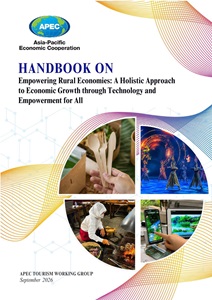
Empowering Rural Economies: A Holistic Approach to Economic Growth through Technology and Empowerment for All
The Asia-Pacific Economic Cooperation (APEC) is a regional economic forum established in 1989 to leverage the growing interdependence of the Asia-Pacific.
The Asia-Pacific Economic Cooperation (APEC) is a regional economic forum established in 1989 to leverage the growing interdependence of the Asia-Pacific.
APEC ensures that goods, services, investment and people move easily across borders. Members facilitate this trade through faster customs procedures at borders; more favorable business climates behind the border; and aligning regulations and standards across the region.
APEC ensures that goods, services, investment and people move easily across borders. Members facilitate this trade through faster customs procedures at borders; more favorable business climates behind the border; and aligning regulations and standards across the region.
APEC has helped drive economic growth and cooperation across the Asia-Pacific by reducing trade barriers, improving the ease of doing business and strengthening connectivity among economies. These efforts have contributed to rising incomes, expanded trade and greater opportunities for businesses and communities across the region.
APEC has helped drive economic growth and cooperation across the Asia-Pacific by reducing trade barriers, improving the ease of doing business and strengthening connectivity among economies. These efforts have contributed to rising incomes, expanded trade and greater opportunities for businesses and communities across the region.
APEC brings together governments, businesses and stakeholders to collaborate on shared priorities. Explore opportunities to participate in events, contribute to initiatives and engage with APEC’s work across the region.
APEC brings together governments, businesses and stakeholders to collaborate on shared priorities. Explore opportunities to participate in events, contribute to initiatives and engage with APEC’s work across the region.

Reports
•January 2020
Download Report
658KB
Published Under
Committee on Trade and Investment (CTI), Group on Services (GOS)
Accessed
5751
Pages
76
The study on APEC’s Non-Binding Principles for Domestic Regulation of the Services Sector examines the process of developing domestic regulations, focusing on the transparency provisions of APEC’s Non-Binding Domestic Regulation Principles: publishing and making information available, advanced notice and opportunity to comment, and establishment of enquiry points. It is complemented by inputs from an APEC workshop held in Chile in August 2019 and provides an analysis of transparency and predictability principles in select recent trade agreements and initiatives. Preliminary findings present a general outlook of APEC member commitments to transparency principles and challenges and gaps in upholding them.