Reports
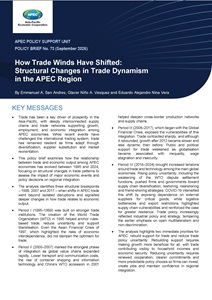
How Trade Winds Have Shifted: Structural Changes in Trade Dynamism in the APEC Region
The Asia-Pacific Economic Cooperation (APEC) is a regional economic forum established in 1989 to leverage the growing interdependence of the Asia-Pacific.
The Asia-Pacific Economic Cooperation (APEC) is a regional economic forum established in 1989 to leverage the growing interdependence of the Asia-Pacific.
APEC ensures that goods, services, investment and people move easily across borders. Members facilitate this trade through faster customs procedures at borders; more favorable business climates behind the border; and aligning regulations and standards across the region.
APEC ensures that goods, services, investment and people move easily across borders. Members facilitate this trade through faster customs procedures at borders; more favorable business climates behind the border; and aligning regulations and standards across the region.
APEC has helped drive economic growth and cooperation across the Asia-Pacific by reducing trade barriers, improving the ease of doing business and strengthening connectivity among economies. These efforts have contributed to rising incomes, expanded trade and greater opportunities for businesses and communities across the region.
APEC has helped drive economic growth and cooperation across the Asia-Pacific by reducing trade barriers, improving the ease of doing business and strengthening connectivity among economies. These efforts have contributed to rising incomes, expanded trade and greater opportunities for businesses and communities across the region.
APEC brings together governments, businesses and stakeholders to collaborate on shared priorities. Explore opportunities to participate in events, contribute to initiatives and engage with APEC’s work across the region.
APEC brings together governments, businesses and stakeholders to collaborate on shared priorities. Explore opportunities to participate in events, contribute to initiatives and engage with APEC’s work across the region.

Proceedings
•February 2010
Download Report
8MB
Published Under
SOM Steering Committee on Economic and Technical Cooperation (SCE), Agricultural Technical Cooperation Working Group (ATCWG)
Accessed
9072
Pages
282
These papers are the presentations of an international conference held in Korea on 15-17 September 2009. This international workshop titled “Developing Bioenergy and Conserving the Natural Ecosystem” provided an opportunity for all the participants to share the experiences of the developing economies regarding to the bioenergy technologies.
Session I
1. "Low Carbon Green Growth" strategy in Korea
2. Biomass Energy From Agriculture, Forestry and Fisheries in Korea
3. Bioenergy in New Zealand
Session II
1. Biomass Strategy and Biomass Town Project in Japan
2. German Biogas Success Story and the Requested Political Framework
3. Opportunities for Biogas Capture and Use from Animal Waste Management
Session III
1. Development of Biogas and Biomass Power Technology in China
2. Case Study of Biogas Production from Plant-Based Materials
and Animal Manure Resources Available In the Cocoa and Coffee Farms
3. Treatment of Wastewater and Sludge in China, and its Perspective as Bio-Energy Sources Around Towns for Supplying Energy Needs
4. Biogas Recovery from Piggery Wastewater by Anaerobic Digestion
5. Biogas Development in Viet Nam - Opportunities and Challenges
6. Biogas System from Swine Waste in Thailand
Session IV
1. Production of Bio-crude and Bio-phenols from Agricultural Residues or by-Products through Direct Liquefaction
2. Biodiesel Promotion in Thailand
3. Study on Crude Oil Productions and Supercritical Clean and Green fuels on Application of Liquefaction Technology with Agricultural Biomass
4. Outlook of Palm Biodiesel in Malaysia
Session V
1. Biobutanol Production Technologies with Agricultural Biomass
2. Biobutanol:Green Energy Production
3. Overview of Legal Framework on Biofuels in Viet Nam
4. Development of Biodiesel in China