

Proceedings
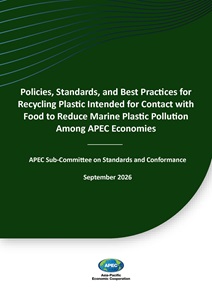
Policies, Standards, and Best Practices for Recycling Plastic Intended for Contact with Food to Reduce Marine Plastic Pollution Among APEC Economies
The Asia-Pacific Economic Cooperation (APEC) is a regional economic forum established in 1989 to leverage the growing interdependence of the Asia-Pacific.
The Asia-Pacific Economic Cooperation (APEC) is a regional economic forum established in 1989 to leverage the growing interdependence of the Asia-Pacific.
APEC ensures that goods, services, investment and people move easily across borders. Members facilitate this trade through faster customs procedures at borders; more favorable business climates behind the border; and aligning regulations and standards across the region.
APEC ensures that goods, services, investment and people move easily across borders. Members facilitate this trade through faster customs procedures at borders; more favorable business climates behind the border; and aligning regulations and standards across the region.
APEC has helped drive economic growth and cooperation across the Asia-Pacific by reducing trade barriers, improving the ease of doing business and strengthening connectivity among economies. These efforts have contributed to rising incomes, expanded trade and greater opportunities for businesses and communities across the region.
APEC has helped drive economic growth and cooperation across the Asia-Pacific by reducing trade barriers, improving the ease of doing business and strengthening connectivity among economies. These efforts have contributed to rising incomes, expanded trade and greater opportunities for businesses and communities across the region.
APEC brings together governments, businesses and stakeholders to collaborate on shared priorities. Explore opportunities to participate in events, contribute to initiatives and engage with APEC’s work across the region.
APEC brings together governments, businesses and stakeholders to collaborate on shared priorities. Explore opportunities to participate in events, contribute to initiatives and engage with APEC’s work across the region.

Reports
•June 2010
Download Report
42MB
Published Under
SOM Steering Committee on Economic and Technical Cooperation (SCE), Policy Partnership on Science, Technology and Innovation (PPSTI)
Accessed
15823
Pages
563
This report presents five economy reports and presentations of the seminar. The objective of the training is the technology transfer about guideline of natural resources development and its environmental impacts, environmental impact assessment, natural resources assessment, public awareness, and measurement of aggregate quality.
1 Enhanced Coalbed Mathane Recovery and CO2 Storage in Coal Seams
2MB
1 Geothermal Reservoir Monitoring Using Multigeophysical Survey Techniques
2MB
1 Remediation of Subsurface Contamination Using Bacteria
906KB
1 The Battle against Landslide Disaster in the Recent History of Japan
9MB
2 Geothermal Reservoir Monitoring with a Combination of Absolute and Relative Gravimetry
747KB
2 Performance and Uncertainty Modeling for Risk Assessment in CO2 Storage Coalbed Methane Reservoirs
618KB
2 Realtime Monitoring of Shallowlandslide Potential Area Using Multiparameter Radar
3MB
2 Soil and Groundwater Contamination Determining the transport properties of low permeability geolog
4MB
3 Their International Trends for Developments and Geological Assessments
17MB
Boso Area 8th
303KB
Characteristics of Sedimentary Basins around Japanese Islands
12MB
Economy Report- China
8MB
Economy Report- Papua New Guinea
7MB
Economy Report- Russia
3MB
Economy Report- Thailand
6MB
Economy Report- Viet Nam
4MB
Environmental Impact Assessment of Exploration Deposits and Project Constructions
4MB
Evaluation Methods for Quality of fine Aggregate
4MB
Field Seminar
11MB
Geo-information Techniques in AIST
3MB
Geological Sequestration of CO2
4MB
Geo-scientific Studies on Methane Gas Hydrates
1MB
Groundwater in the Cities- its past and present
3MB
Introduction
303KB
Marine Fine Aggregate Resources Exploration
16MB
Remote Sensing- Principle and applications in geology
3MB
Risk Governance
1MB
Significance of Natural Gases Dissolved in Aquifers as Energy Resources
3MB
Soil Contamination
5MB
Survey Methods of Marine Fine Aggregate Resources
48MB
Textbook of the Seminar
303KB
Tohoku Region 11th13th
303KB
Proceedings
Policies, Standards, and Best Practices for Recycling Plastic Intended for Contact with Food to Reduce Marine Plastic Pollution Among APEC Economies
Reports
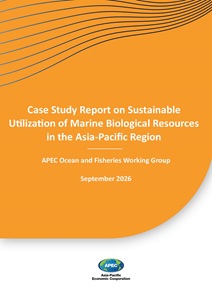
Case Study Report on Sustainable Utilization of Marine Biological Resources in the Asia-Pacific Region
Proceedings
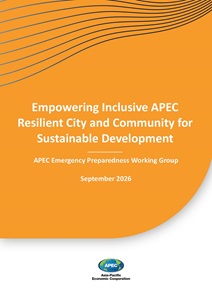
Empowering Inclusive APEC Resilient City and Community for Sustainable Development