

Reports
Advancing Economic Development in the APEC Region: Best Practices for Smart Human–Machine Collaboration in the Heavy Steel Construction Industry
The Asia-Pacific Economic Cooperation (APEC) is a regional economic forum established in 1989 to leverage the growing interdependence of the Asia-Pacific.
The Asia-Pacific Economic Cooperation (APEC) is a regional economic forum established in 1989 to leverage the growing interdependence of the Asia-Pacific.
APEC ensures that goods, services, investment and people move easily across borders. Members facilitate this trade through faster customs procedures at borders; more favorable business climates behind the border; and aligning regulations and standards across the region.
APEC ensures that goods, services, investment and people move easily across borders. Members facilitate this trade through faster customs procedures at borders; more favorable business climates behind the border; and aligning regulations and standards across the region.
APEC has helped drive economic growth and cooperation across the Asia-Pacific by reducing trade barriers, improving the ease of doing business and strengthening connectivity among economies. These efforts have contributed to rising incomes, expanded trade and greater opportunities for businesses and communities across the region.
APEC has helped drive economic growth and cooperation across the Asia-Pacific by reducing trade barriers, improving the ease of doing business and strengthening connectivity among economies. These efforts have contributed to rising incomes, expanded trade and greater opportunities for businesses and communities across the region.
APEC brings together governments, businesses and stakeholders to collaborate on shared priorities. Explore opportunities to participate in events, contribute to initiatives and engage with APEC’s work across the region.
APEC brings together governments, businesses and stakeholders to collaborate on shared priorities. Explore opportunities to participate in events, contribute to initiatives and engage with APEC’s work across the region.

Manuals
•November 2017
Download Report
1MB
Published Under
SOM Steering Committee on Economic and Technical Cooperation (SCE), Experts Group on Illegal Logging and Associated Trade (EGILAT), Committee on Trade and Investment (CTI), Sub-Committee on Customs Procedures (SCCP)
Accessed
13295
Pages
14
This report was prepared with inputs from experts and speaker presentations at the APEC EGILAT-SCCP Workshop on Customs Best Practices to Identify Illegal Wood and Wood Products held in Ho Chi Minh City, Viet Nam from 18-19 August 2017. The workshop aimed to share best customs practices in responding to trade in illegal wood products, and to strengthen attendees’ abilities to identify legally and illegally traded wood products and take appropriate action when necessary.
Workshop sessions centered around topics of (1) protocols and methodologies to target illegal timber; (2) best practices for timber identification; (3) legal wood product certification programs; (4) protocols for documentation and data review to monitor compliance legality; (5) utilizing timber traceability systems; and (6) taking appropriate actions on illegal shipments. The workshop served as a platform to bring customs officials together around these issues, and highlighted the high level of interest and need for customs and forestry officials to work on identifying and combatting trade in illegal timber and wood products. The workshop also served as a venue for participants to expand their professional networks for a continued exchange of information and future cooperation.
Reports
Advancing Economic Development in the APEC Region: Best Practices for Smart Human–Machine Collaboration in the Heavy Steel Construction Industry
Proceedings
APEC Workshop on Shaping Digital Transformation in Accreditation
Manuals
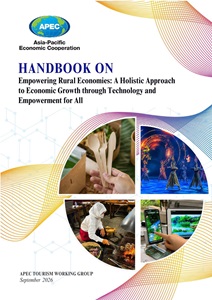
Empowering Rural Economies: A Holistic Approach to Economic Growth through Technology and Empowerment for All