Reports
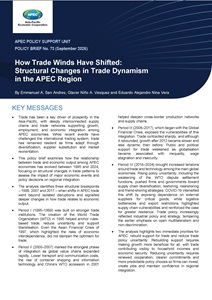
How Trade Winds Have Shifted: Structural Changes in Trade Dynamism in the APEC Region
The Asia-Pacific Economic Cooperation (APEC) is a regional economic forum established in 1989 to leverage the growing interdependence of the Asia-Pacific.
The Asia-Pacific Economic Cooperation (APEC) is a regional economic forum established in 1989 to leverage the growing interdependence of the Asia-Pacific.
APEC ensures that goods, services, investment and people move easily across borders. Members facilitate this trade through faster customs procedures at borders; more favorable business climates behind the border; and aligning regulations and standards across the region.
APEC ensures that goods, services, investment and people move easily across borders. Members facilitate this trade through faster customs procedures at borders; more favorable business climates behind the border; and aligning regulations and standards across the region.
APEC has helped drive economic growth and cooperation across the Asia-Pacific by reducing trade barriers, improving the ease of doing business and strengthening connectivity among economies. These efforts have contributed to rising incomes, expanded trade and greater opportunities for businesses and communities across the region.
APEC has helped drive economic growth and cooperation across the Asia-Pacific by reducing trade barriers, improving the ease of doing business and strengthening connectivity among economies. These efforts have contributed to rising incomes, expanded trade and greater opportunities for businesses and communities across the region.
APEC brings together governments, businesses and stakeholders to collaborate on shared priorities. Explore opportunities to participate in events, contribute to initiatives and engage with APEC’s work across the region.
APEC brings together governments, businesses and stakeholders to collaborate on shared priorities. Explore opportunities to participate in events, contribute to initiatives and engage with APEC’s work across the region.

Proceedings
•January 2022
Download Report
3MB
Published Under
SOM Steering Committee on Economic and Technical Cooperation (SCE), Energy Working Group (EWG)
Accessed
1757
Pages
26
A community-based waste management is an alternative to overcome or minimize waste accumulation in sites managed by the local or regional government. The objective of this project is to encourage application of waste management to renewable energy project through community involvement and engagement, as one of sustainable solutions for the waste crisis. The project also responds to APEC energy goals of doubling the share of renewable energy by 2030.
This report contains summary of presentations from all of the speakers in the workshop held virtually, which aimed to (1) increase knowledge and understanding of waste management to renewable energy in Asia-Pacific economies and (2) foster community self-reliance in waste management. The report also contains the results from evaluation, as well as summary and recommendations obtained from this workshop.