Reports
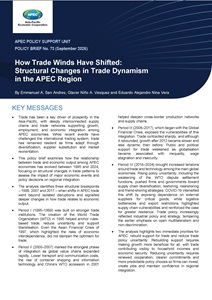
How Trade Winds Have Shifted: Structural Changes in Trade Dynamism in the APEC Region
The Asia-Pacific Economic Cooperation (APEC) is a regional economic forum established in 1989 to leverage the growing interdependence of the Asia-Pacific.
The Asia-Pacific Economic Cooperation (APEC) is a regional economic forum established in 1989 to leverage the growing interdependence of the Asia-Pacific.
APEC ensures that goods, services, investment and people move easily across borders. Members facilitate this trade through faster customs procedures at borders; more favorable business climates behind the border; and aligning regulations and standards across the region.
APEC ensures that goods, services, investment and people move easily across borders. Members facilitate this trade through faster customs procedures at borders; more favorable business climates behind the border; and aligning regulations and standards across the region.
APEC has helped drive economic growth and cooperation across the Asia-Pacific by reducing trade barriers, improving the ease of doing business and strengthening connectivity among economies. These efforts have contributed to rising incomes, expanded trade and greater opportunities for businesses and communities across the region.
APEC has helped drive economic growth and cooperation across the Asia-Pacific by reducing trade barriers, improving the ease of doing business and strengthening connectivity among economies. These efforts have contributed to rising incomes, expanded trade and greater opportunities for businesses and communities across the region.
APEC brings together governments, businesses and stakeholders to collaborate on shared priorities. Explore opportunities to participate in events, contribute to initiatives and engage with APEC’s work across the region.
APEC brings together governments, businesses and stakeholders to collaborate on shared priorities. Explore opportunities to participate in events, contribute to initiatives and engage with APEC’s work across the region.

Reports
•May 2023
Download Report
8MB
Published Under
Energy Working Group (EWG)
Accessed
842
Pages
144
Islanded power systems provide a unique context for demonstrating how low carbon power systems may be achieved as conventional generation is replaced. As such, they may be considered ‘trailblazers’ for power system transformation, offering early insights into the future operational challenges faced by GW-scale power systems as they undergo deep decarbonisation.
This report considers the broad range of issues contributing to or hindering the uptake of Variable Renewable Energy (VRE) in islanded power systems across strategy and planning, technical, regulatory and policy, and market and economic domains. Part 1 of the report is an amalgamation of an expansive scan of the global literature, together with a distillation of key takeaways from the case studies explored in Part 2. Part 2 provides a detailed account of transferable lessons learnt in deploying and enabling VRE across ten specific and diverse case studies based on published information and interviews with power system operators, vendors and policy makers.