Reports
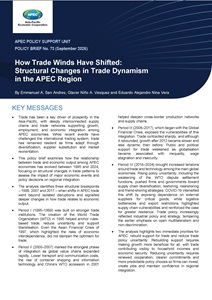
How Trade Winds Have Shifted: Structural Changes in Trade Dynamism in the APEC Region
The Asia-Pacific Economic Cooperation (APEC) is a regional economic forum established in 1989 to leverage the growing interdependence of the Asia-Pacific.
The Asia-Pacific Economic Cooperation (APEC) is a regional economic forum established in 1989 to leverage the growing interdependence of the Asia-Pacific.
APEC ensures that goods, services, investment and people move easily across borders. Members facilitate this trade through faster customs procedures at borders; more favorable business climates behind the border; and aligning regulations and standards across the region.
APEC ensures that goods, services, investment and people move easily across borders. Members facilitate this trade through faster customs procedures at borders; more favorable business climates behind the border; and aligning regulations and standards across the region.
APEC has helped drive economic growth and cooperation across the Asia-Pacific by reducing trade barriers, improving the ease of doing business and strengthening connectivity among economies. These efforts have contributed to rising incomes, expanded trade and greater opportunities for businesses and communities across the region.
APEC has helped drive economic growth and cooperation across the Asia-Pacific by reducing trade barriers, improving the ease of doing business and strengthening connectivity among economies. These efforts have contributed to rising incomes, expanded trade and greater opportunities for businesses and communities across the region.
APEC brings together governments, businesses and stakeholders to collaborate on shared priorities. Explore opportunities to participate in events, contribute to initiatives and engage with APEC’s work across the region.
APEC brings together governments, businesses and stakeholders to collaborate on shared priorities. Explore opportunities to participate in events, contribute to initiatives and engage with APEC’s work across the region.
Reports
•September 2022
Download Report
4MB
Published Under
SOM Steering Committee on Economic and Technical Cooperation (SCE), Policy Partnership on Women and the Economy (PPWE)
Accessed
1600
Pages
63
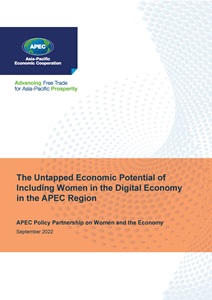
This study aimed to perform an economic estimate of the untapped potential of including women in the digital economy in the APEC region. Data from the Economist Intelligence Unit and the World Bank’s Gender Data Portal were used to construct indicators of access to the internet and STEM careers. Different sources of data were used to explore economic determinants. A socio-economic model was calibrated to find significant variables in female access to the digital economy. The most relevant variables were educational variables, cost of access to technology, infrastructure, and government policies. The cost of the untapped economic potential of including women in the digital economy was estimated for 2020 at 94 billion dollars in the APEC region. APEC economies should promote efforts to ensure the availability and frequency of measurement of gender-related indicators to determine if women are effectively accessing the digital economy.