Reports
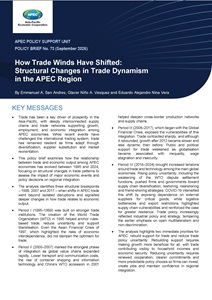
How Trade Winds Have Shifted: Structural Changes in Trade Dynamism in the APEC Region
The Asia-Pacific Economic Cooperation (APEC) is a regional economic forum established in 1989 to leverage the growing interdependence of the Asia-Pacific.
The Asia-Pacific Economic Cooperation (APEC) is a regional economic forum established in 1989 to leverage the growing interdependence of the Asia-Pacific.
APEC ensures that goods, services, investment and people move easily across borders. Members facilitate this trade through faster customs procedures at borders; more favorable business climates behind the border; and aligning regulations and standards across the region.
APEC ensures that goods, services, investment and people move easily across borders. Members facilitate this trade through faster customs procedures at borders; more favorable business climates behind the border; and aligning regulations and standards across the region.
APEC has helped drive economic growth and cooperation across the Asia-Pacific by reducing trade barriers, improving the ease of doing business and strengthening connectivity among economies. These efforts have contributed to rising incomes, expanded trade and greater opportunities for businesses and communities across the region.
APEC has helped drive economic growth and cooperation across the Asia-Pacific by reducing trade barriers, improving the ease of doing business and strengthening connectivity among economies. These efforts have contributed to rising incomes, expanded trade and greater opportunities for businesses and communities across the region.
APEC brings together governments, businesses and stakeholders to collaborate on shared priorities. Explore opportunities to participate in events, contribute to initiatives and engage with APEC’s work across the region.
APEC brings together governments, businesses and stakeholders to collaborate on shared priorities. Explore opportunities to participate in events, contribute to initiatives and engage with APEC’s work across the region.
-in-the-apec-region.tmb-h300.jpg?Culture=en&sfvrsn=9fbe2b57_1)
Reports
•September 2024
Download Report
1MB
Published Under
Committee on Trade and Investment (CTI)
Accessed
2249
Pages
34
This publication examines APEC's participation in Global Value Chains (GVCs) using the OECD-TiVA database, focusing on trends from 1995 to 2020. Key findings include: 1) The manufacturing sector leads in both domestic and foreign value-added exports, 2) APEC is a major supplier (forward participation) in sectors like distributive trade, transport, accommodation and food services, other business services, and chemical products. As a buyer (backward participation), it is prominent in distributive trade, transport, accommodation and food services, mining, energy-producing products, and other business sector services 3) APEC’s primary trading partners in forward participation are Ireland, Germany, the Netherlands, France, the United Kingdom, and India, while in backward participation, key partners include Germany, India, the United Kingdom, Saudi Arabia, and Brazil.