Reports
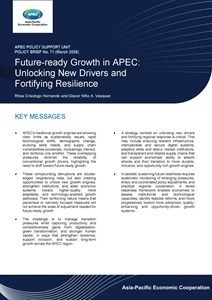
Future-ready Growth in APEC: Unlocking New Drivers and Fortifying Resilience
The Asia-Pacific Economic Cooperation (APEC) is a regional economic forum established in 1989 to leverage the growing interdependence of the Asia-Pacific.
The Asia-Pacific Economic Cooperation (APEC) is a regional economic forum established in 1989 to leverage the growing interdependence of the Asia-Pacific.
APEC ensures that goods, services, investment and people move easily across borders. Members facilitate this trade through faster customs procedures at borders; more favorable business climates behind the border; and aligning regulations and standards across the region.
APEC ensures that goods, services, investment and people move easily across borders. Members facilitate this trade through faster customs procedures at borders; more favorable business climates behind the border; and aligning regulations and standards across the region.
APEC has helped drive economic growth and cooperation across the Asia-Pacific by reducing trade barriers, improving the ease of doing business and strengthening connectivity among economies. These efforts have contributed to rising incomes, expanded trade and greater opportunities for businesses and communities across the region.
APEC has helped drive economic growth and cooperation across the Asia-Pacific by reducing trade barriers, improving the ease of doing business and strengthening connectivity among economies. These efforts have contributed to rising incomes, expanded trade and greater opportunities for businesses and communities across the region.
APEC brings together governments, businesses and stakeholders to collaborate on shared priorities. Explore opportunities to participate in events, contribute to initiatives and engage with APEC’s work across the region.
APEC brings together governments, businesses and stakeholders to collaborate on shared priorities. Explore opportunities to participate in events, contribute to initiatives and engage with APEC’s work across the region.
Reports
•August 2021
Download Report
4MB
Published Under
APEC Secretariat, APEC Policy Support Unit
Accessed
7215
Pages
81
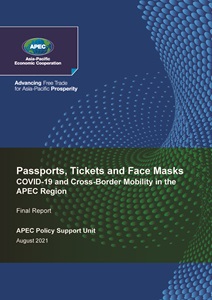
Cross-border movement of people is essential for trade and economic activity. Apart from the linkages in terms of tourism and transportation, cross-border movements of people contribute to economic growth by enabling logistics and supply chains, investments, employment, education, and capacity building. Indeed, using data up to 2019, the study finds strong and synergistic linkages between cross-border movement and bilateral trade and economic growth. But in 2020, the COVID-19 pandemic led to border closures and restrictions as economies sought to contain the virus.
A survey conducted in late 2020 shows many similarities in the types of measures implemented at borders, but also highlights many variations and differences in the details of how these measures are implemented. These border measures have led to uncertainty for travelers and quashed demand: airline booking data indicate that cross-border arrivals in APEC fell by 75% in 2020. While the effectiveness of these border restrictions in preventing imported cases from seeding waves of the pandemic is mixed, their impact on trade, economic activity, and people are immediate and substantial. Estimated direct trade losses due to the fall in cross-border movement range from USD 488 billion to USD 786 billion, while losses from unrealized economic activity is estimated at USD 1.2 trillion.
Previous attempts at safe reopening have been tentative and uncertain due to the changing COVID-19 situation around the region. This study presents some recommendations to enable safe reopening of borders and outlines a role for APEC.