

Chengdu, People's Republic of China
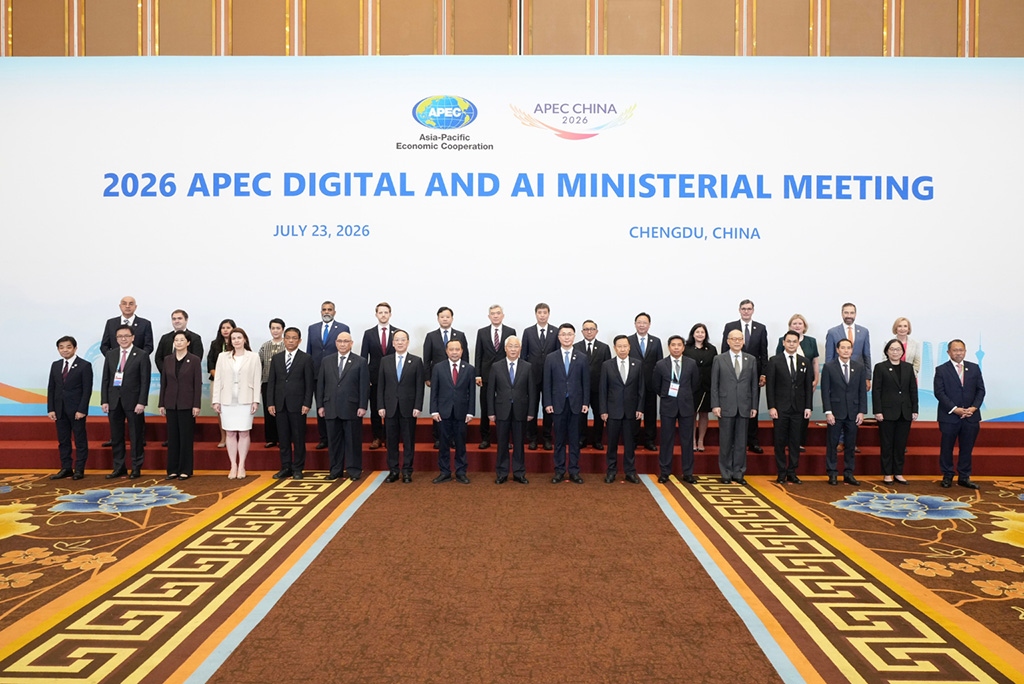
•23 July 2026
2026 APEC Digital and AI Ministerial Statement
2026 APEC Digital and AI Ministerial Statement
“Digital Technologies and AI for the Empowerment of an Asia-Pacific Community”
(Chengdu Statement)
Chengdu, People’s Republic of China
23 July 2026
Introduction
1. We, the Asia-Pacific Economic Cooperation (APEC) Ministers responsible for telecommunications/information and communication technologies (ICTs) and digital policy, met in Chengdu, People’s Republic of China, on 23 July 2026, chaired by H.E. Li Lecheng, Minister of Industry and Information Technology of the People’s Republic of China.
2. Under the theme of “Digital Technologies and AI for the Empowerment of an Asia-Pacific Community”, which aligns with the APEC 2026 theme of “Building an Asia-Pacific Community to Prosper Together” and China’s APEC priorities of “Openness, Innovation, Cooperation”, we continue to be guided by our collective mission as set forth in the APEC Putrajaya Vision 2040 for an open, dynamic, resilient and peaceful Asia-Pacific community by 2040, for the prosperity of all our people and future generations, including through the implementation of the APEC Internet and Digital Economy Roadmap and the APEC Artificial Intelligence (AI) Initiative (2026-2030).
3. We also note that APEC is a facilitator of long-term economic growth in the region through the deployment of digital technologies and AI, in line with the commitments of the 2025 APEC Digital and AI Ministerial Meeting. We reaffirm that APEC is well positioned to promote digital technologies and AI for the empowerment of the Asia-Pacific region, while acknowledging member economies’ different approaches to their respective digital and AI policies.
I. Universal and Meaningful Digital Connectivity
4. We recognize the importance of enabling everyone to have secure, reliable and affordable access to digital connectivity, which provides significant benefits for society. We encourage member economies to strengthen cooperation with stakeholders, including the private sector, to develop reliable, accessible, scalable, trusted, secure and resilient communication infrastructure. We also encourage cooperation to support an enabling environment for next-generation connectivity technologies and services, including the rational, efficient and economical use of spectrum and satellite orbital resources.
5. We believe in the need for universal and meaningful digital connectivity across regions, between urban and rural areas and among all segments of our societies. We encourage a particular focus on improving the affordability, accessibility and quality of networks in underserved, rural and remote areas, as well as improving digital access for all, so that everyone can meaningfully engage in the digital economy and benefit from it. We believe in the benefits that new technologies can bring to provide resilience and last-mile connectivity and bring all into the global economy.
6. Noting the rapid advancement of digital technologies and Al, we encourage member economies to enhance cooperation and promote investment in digital connectivity infrastructure through information exchange and capacity building among APEC economies. We will also continue our cooperation on facilitating the flow of data and strengthening consumer and business trust in digital transactions.
II. Digital Technologies and AI for Economic Growth
7. Recognizing that digital technologies and AI empower member economies to enhance productivity, efficiency and resilience and support economic growth, we encourage member economies to accelerate innovation and the responsible adoption of digital technologies and AI, in order to fully unlock these technologies’ benefits across diverse fields.
8. We encourage member economies to promote the digital and AI transformation of sectors such as manufacturing, agriculture and services, and strengthen cooperation in this regard by sharing relevant policies, experiences and best practices. Recognizing that digital and AI transformation is pivotal for micro-, small- and medium-sized enterprises (MSMEs) to enhance their competitiveness, we further encourage member economies to continue supporting MSMEs by providing affordable and easy-to-deploy digital products and solutions, and encouraging their responsible adoption. We welcome prior and ongoing efforts to foster MSME advancement, including efforts to promote the transition from the informal to formal economy by creating an enabling environment for innovation and entrepreneurship.
9. We note the potential of digital technologies and AI to improve public service delivery and drive economic growth for all people in the APEC region. We encourage member economies to continue to support human-centered, locally tailored AI products and services, including those that reflect the diverse needs of APEC economies and that leverage AI to enhance and ensure people’s well-being. We commend and encourage member economies’ efforts to promote AI-empowered economic growth for all.
III. Digital Literacy and Skills Enhancement for All
10. We recognize that digital literacy including AI literacy and skills is essential to achieve meaningful digital adoption. We encourage member economies to broaden access to education and share best practices and experiences on digital education and vocational training in schools and communities. We reaffirm our continued commitment to equip our people with digital literacy and skills to support their ability to access, understand and utilize digital technologies, recognizing these skills can empower everyone to fully, critically and confidently engage in the digital world and leverage digital tools and services for personal and professional development.
11. Recognizing that it is essential to increase public awareness and understanding of AI, we encourage AI adoption through capacity building within the APEC region, including through voluntary experience sharing, training, technical assistance, scalability and public education programs to enhance AI expertise and awareness, and maximize the benefits of AI. This involves fostering AI literacy among policymakers to ensure they can effectively understand and promote the responsible development and adoption of AI systems. We encourage member economies to promote the voluntary sharing of digital and AI-related knowledge and technologies on mutually acceptable terms, with a view toward facilitating access to digital and AI tools and best practices for member economies.
IV. Trusted Digital Environment
12. We acknowledge risks such as data breaches, online scams and the deliberate misuse of AI and other emerging technologies. We express deep concern over the escalation of online scam activities across our region, which threaten the financial security of individuals and businesses, erode public trust in digital systems, and undermine confidence in our broader digital economy. We recognize that stepping up efforts to promote awareness of and mitigate these risks is essential to maintaining trust and confidence. We call on member economies to promote innovation that addresses these risks, including through cooperation and the exchange of information and best practices among member economies, with the goal of building a safe, secure, reliable, trusted and resilient digital environment.
13. We encourage member economies to voluntarily engage with governments, appropriate specialized organizations, the private sector, civil society, technical community and academia to share best practices in the areas of ICT security, data protection, supply chain resilience, digital infrastructure resilience, technical standards, anti-online scam measures and child online protection. We further encourage industry to enhance accountability, promote the secure, reliable and resilient use of digital technologies, including AI, and enhance the privacy, trust and confidence of consumers, businesses and the public.
V. Investment and Open Source for Digital Ecosystem
14. Recognizing comprehensive digital and AI transformation requires significant investment in digital connectivity and energy infrastructure, we encourage continued engagement of investors and venture capital institutions to expand access to financing and related support for digital and AI transformation, particularly for MSMEs and start-ups.
15. We note the important role of trusted open-source approaches in unlocking the potential of digital technologies and fostering innovation in the digital economy. While respecting security, data protection and intellectual property rights, we encourage member economies to support open-source models and projects that employ strong security assurance through development and deployment. We also encourage member economies to engage in cooperation with open-source communities.
Conclusion
16. We note the APEC projects supporting digital infrastructure, security, technology, scalability and interoperability, which have made significant contributions to advancing policy exchange, digital connectivity, and trade facilitation across the region. We commend the work and significant achievements of the APEC Telecommunications and Information Working Group (TELWG), Digital Economy Steering Group (DESG) and other APEC sub-fora, and encourage them to further explore ways to leverage digital technologies and AI to empower the Asia-Pacific community. We also note the work of the APEC Business Advisory Council (ABAC) in support of TELWG.
17. We acknowledge the positive progress made by member economies in expanding the digital economy, and fostering connectivity and digital transformation for the benefit of our people and the region.
18. We express our appreciation to the People’s Republic of China for hosting this meeting and to the city of Chengdu and Sichuan Province for their exceptional hospitality extended at this meeting. We look forward to meeting again in Viet Nam in 2027.