

Preparing for What’s Next: A Tiered Approach to Growth in APEC

APEC’s traditional growth engines are under strain. Sustainability pressures, rapid technological change, demographic shifts, evolving skills needs and fragile supply chains are increasingly interacting, creating a more complex and uncertain economic environment.
While these forces intensify risks, they also open pathways to new growth drivers. This is pushing economies to move beyond piecemeal responses and adopt more coordinated strategies that harness digitalization, green transformation and stronger human capital to boost productivity, resilience and inclusion.
How economies prepare for these shifts will shape their ability to sustain growth in the years ahead.
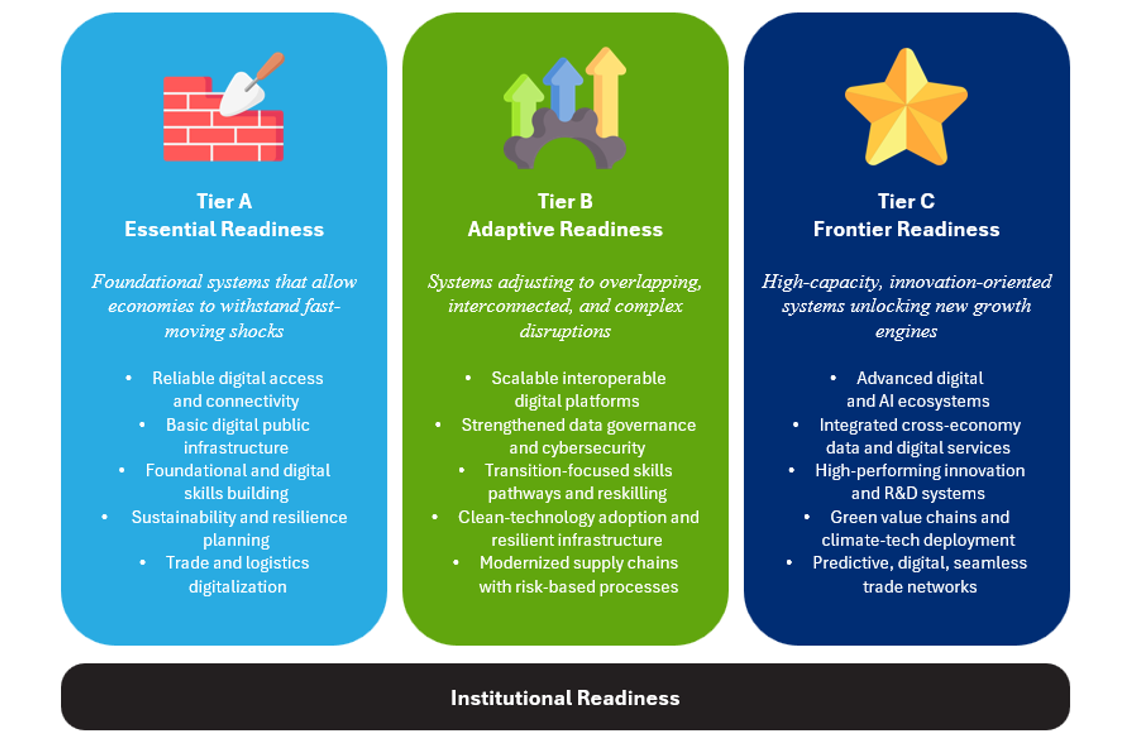
One approach highlighted in a recent policy brief by the APEC Policy Support Unit is the tiered readiness framework. At its core, the framework is a practical tool to assess how prepared economies are across key systems and where reforms are needed. It uses three broad tiers to determine economies’ readiness, reflecting various levels of capability and policy maturity.
Rather than prescribing a single pathway, the framework provides a structured lens to prepare and take advantage of emerging opportunities amid a rapidly evolving economic landscape.
Why a Readiness Framework Matters
The transformations unfolding across the region are complex and interconnected. Weather-related disruptions can strain infrastructure and supply chains. Technological change is reshaping labor markets and competitiveness. Demographic aging is tightening labor supply while increasing fiscal pressures. In addition, supply chain shocks continue to highlight vulnerabilities in global production networks.
These pressures increasingly reinforce one another, meaning that interventions focused on a single issue may not be sufficient. Economies need a way to evaluate how their institutions, infrastructure and policies can respond to multiple challenges simultaneously.
The tiered readiness framework offers a way to organize this assessment. It helps economies identify their current capabilities, consider which reforms may be feasible given domestic conditions and situate their progress within a broader regional context. Importantly, the framework does not rank economies or impose rigid timelines. Instead, it recognizes that economies start from different positions and will advance at different speeds.
Tier A: Building the Foundations
The first level of the framework focuses on essential readiness. At this stage, the priority is to ensure that basic systems are in place so economies can withstand fast-moving shocks and participate in emerging economic opportunities.
Key foundations often include reliable digital connectivity, basic digital public infrastructure and early investments in skills development. Systems for sustainability planning, disaster preparedness and the digitalization of trade and logistics also form part of this initial layer of readiness.
These capabilities provide the groundwork for broader economic participation. For example, access to affordable broadband and digital services can allow businesses and households to connect to new markets and technologies. Similarly, early investments in foundational education and digital literacy can help workers engage with an increasingly technology-driven economy.
In essence, Tier A represents the stage where economies establish the fundamental infrastructure and institutional capacity needed to operate effectively in a more digital and interconnected environment.
Tier B: Adapting to Structural Change
As economies strengthen their foundations, the focus gradually shifts toward adaptive readiness. At this stage, systems begin to adjust more actively to structural transitions driven by technology, sustainability and demographic change.
Economies operating at this level typically develop more scalable and interoperable digital platforms, allowing public and private systems to interact more efficiently. Data governance frameworks and cybersecurity capabilities also become more sophisticated, supporting greater digital integration across sectors and borders.
In addition, adaptive readiness involves preparing economic systems for long-term transitions. Skills systems may evolve to support lifelong learning and reskilling, particularly as automation and innovative technologies reshape job requirements. Infrastructure planning may incorporate climate resilience and sustainability considerations. Supply chains may increasingly rely on risk-management tools and diversified sourcing strategies.
Tier B reflects a stage where economies are not only building capacity but actively adapting institutions and systems to manage change.
Tier C: Competing at the Frontier
The third level, frontier readiness, represents the stage where economies are positioned to unlock new growth engines and operate at the technological frontier.
Here, advanced digital ecosystems, including artificial intelligence and integrated data systems, have become central drivers of productivity and innovation. Economies may develop strong research and development ecosystems, high-capacity data infrastructure, and collaborative networks linking universities, firms and research institutions.
At the same time, economic systems become increasingly interconnected and predictive. Trade networks may use real-time logistics data and advanced analytics to anticipate disruptions and manage supply chains more efficiently. Green value chains and climate-technology industries may also emerge as new drivers of growth.
In this stage, readiness is not only about resilience; more importantly, it is about creating the conditions for innovation-led expansion.
Institutions as the Anchor
One factor stands out as a consistent anchor across all tiers: institutional readiness. Strong governance, transparent rules, accountable public institutions and stable macroeconomic conditions shape how effectively economies can implement reforms and respond to emerging pressures. Institutions also play a crucial role in fostering trust: a vital ingredient for investment, innovation and regional cooperation.
Since institutional capacity underpins progress across every tier, strengthening governance frameworks remains central to sustaining long-term resilience and enabling effective policy implementation.
A Shared Path, Different Starting Points
One of the key insights of the tiered readiness framework is that progress toward future-ready growth will not follow a single trajectory. APEC economies differ widely in their levels of technological development, institutional capacity and resource availability.
The framework acknowledges these differences while still offering a shared reference point. By mapping capabilities across tiers, economies can better understand their position, identify areas for improvement and explore opportunities for cooperation with regional partners.
In a period marked by rapid technological change, environmental pressures and shifting global supply chains, such tools can help policymakers navigate uncertainty.
The tiered readiness framework does not provide a fixed roadmap. Instead, it offers a structured way for economies to assess their readiness, prioritize reforms and coordinate responses to shared challenges. In a shifting global economic landscape, this approach may prove critical to sustaining growth and resilience across the APEC region.
Rhea Crisologo Hernando is analyst at the APEC Policy Support Unit.
For more on this topic, read the full policy brief Future-ready Growth in APEC: Unlocking New Drivers and Fortifying Resilience.