Reports
Future-ready Growth in APEC: Unlocking New Drivers and Fortifying Resilience
The Asia-Pacific Economic Cooperation (APEC) is a regional economic forum established in 1989 to leverage the growing interdependence of the Asia-Pacific.
The Asia-Pacific Economic Cooperation (APEC) is a regional economic forum established in 1989 to leverage the growing interdependence of the Asia-Pacific.
APEC ensures that goods, services, investment and people move easily across borders. Members facilitate this trade through faster customs procedures at borders; more favorable business climates behind the border; and aligning regulations and standards across the region.
APEC ensures that goods, services, investment and people move easily across borders. Members facilitate this trade through faster customs procedures at borders; more favorable business climates behind the border; and aligning regulations and standards across the region.
APEC has helped drive economic growth and cooperation across the Asia-Pacific by reducing trade barriers, improving the ease of doing business and strengthening connectivity among economies. These efforts have contributed to rising incomes, expanded trade and greater opportunities for businesses and communities across the region.
APEC has helped drive economic growth and cooperation across the Asia-Pacific by reducing trade barriers, improving the ease of doing business and strengthening connectivity among economies. These efforts have contributed to rising incomes, expanded trade and greater opportunities for businesses and communities across the region.
APEC brings together governments, businesses and stakeholders to collaborate on shared priorities. Explore opportunities to participate in events, contribute to initiatives and engage with APEC’s work across the region.
APEC brings together governments, businesses and stakeholders to collaborate on shared priorities. Explore opportunities to participate in events, contribute to initiatives and engage with APEC’s work across the region.
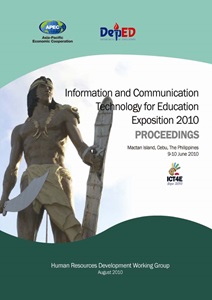
Proceedings
•December 2010
Download Report
4MB
Published Under
SOM Steering Committee on Economic and Technical Cooperation (SCE), Human Resources Development Working Group (HRDWG)
Accessed
22444
Pages
101
INTRODUCTION
KEYNOTE PRESENTATIONS
• APEC Education Projects in ICT Area and the Holistic System Approach
• APEC Cyber Academy: An International Virtual Learning Environment Founded on PBL and Game-based Learning
• ICT in the Global Era: The UP Open University Experience
• Strategies for Introducing ICT in Higher Education
• ICT4E in the Philippines: Status, Issues and Prospects
PANEL PRESENTATIONS
PANEL DISCUSSION 1: APEC ICT4E Initiatives 27
• Korea APEC Projects and Outcomes
• eSkwela: ICT for the Alternative Learning System
PANEL DISCUSSION II: ICT4E and the APEC Economies
• ICT in Basic Education in China
• ICTs in Schools: A Developmental Matrix
• OLPC in Peru: The Real Meaning of Education Quality Improvement
• APEC Human Resources Development Knowledge Bank Library and Wiki
PANEL DISCUSSION III: ICT4E Donor and Private Sector Initiative
• ICT4E: An Inquiry on Policy and Practice in Southeast Asia
• Telecentre.org Academy: Preparing 1 Million Knowledge Workers by 2015
• APC’s Initiatives and Experience in Adopting Moodle as LMS in Higher Education and Sugar Learning Technology
• SCM Practices in Higher Educational Institutions
• CPSC Innovative Blended Learning
• ICT-Supported Distance Education towards Lifelong Learning for All in Asia
• One Laptop per Pacific Child: Building Momentum for Change in the Developing World (A Field Report)
• Impact of Branding in Higher Educational Institutions: Indian Perspective
• ICT Integration for Basic Education: Facilitating and Impeding Factors
PANEL DISCUSSION IV: ICT4E Agency Initiatives in the Philippines
• Minimizing the Digital Divide in Science and Mathematics Education
• eTESDA: Expanding Access and Opportunities to Quality TVET thru ICT
• Enhancing Learning Opportunities through CICT’s ICT4BE Program
• E-Driven Learning: On-line question-posing and peer assessment as means for web-based knowledge sharing in learning Mathematics
• The GENYO Experience: Issues and Challenges in Implementing an Online Learning System for Basic Education in the Philippines
SUMMARY OF OPEN FORUM
• The role of a holistic and ICT-supported education and human resource development in improving the performance of students
• Extending the beneficiaries of ICT4E plans and programs to include the out-of-school youth
• ICT4E and the developing economies
• ICT4E and Intellectual Property Rights
APPENDICES