

Reports
Structural Reform and Residents' Income Growth in APEC Economies: Empirical Assessment and Case Studies
The Asia-Pacific Economic Cooperation (APEC) is a regional economic forum established in 1989 to leverage the growing interdependence of the Asia-Pacific.
The Asia-Pacific Economic Cooperation (APEC) is a regional economic forum established in 1989 to leverage the growing interdependence of the Asia-Pacific.
APEC ensures that goods, services, investment and people move easily across borders. Members facilitate this trade through faster customs procedures at borders; more favorable business climates behind the border; and aligning regulations and standards across the region.
APEC ensures that goods, services, investment and people move easily across borders. Members facilitate this trade through faster customs procedures at borders; more favorable business climates behind the border; and aligning regulations and standards across the region.
APEC has helped drive economic growth and cooperation across the Asia-Pacific by reducing trade barriers, improving the ease of doing business and strengthening connectivity among economies. These efforts have contributed to rising incomes, expanded trade and greater opportunities for businesses and communities across the region.
APEC has helped drive economic growth and cooperation across the Asia-Pacific by reducing trade barriers, improving the ease of doing business and strengthening connectivity among economies. These efforts have contributed to rising incomes, expanded trade and greater opportunities for businesses and communities across the region.
APEC brings together governments, businesses and stakeholders to collaborate on shared priorities. Explore opportunities to participate in events, contribute to initiatives and engage with APEC’s work across the region.
APEC brings together governments, businesses and stakeholders to collaborate on shared priorities. Explore opportunities to participate in events, contribute to initiatives and engage with APEC’s work across the region.
Reports
•February 2018
Download Report
806KB
Published Under
APEC Secretariat, APEC Policy Support Unit
Accessed
17373
Pages
9
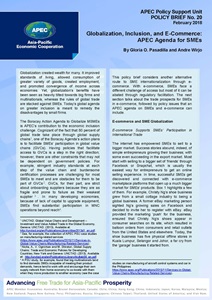
The Boracay Action Agenda is APEC’s response to the inclusion challenge for SMEs to benefit more from globalization. One way to help SMEs to internationalize is by facilitating their participation in global value chains. Onboarding them in GVC’s, however, is not easy because of stringent industry standards and costly certification processes that few SMEs can afford. GVCs, for their part, are wary about fragile suppliers. Fortunately, another route to SME internationalization exists through e-commerce.
This policy brief builds on the 2017 PSU study on Promoting E-commerce to Globalize MSMEs and discusses the trade prospects in e-commerce and policy issues that an APEC agenda on SMEs and e-commerce can include.
Reports
Structural Reform and Residents' Income Growth in APEC Economies: Empirical Assessment and Case Studies
Proceedings
2025 APEC Symposium on Energy Transition: Batteries, Fuel Cells & Electric Vehicles - Project Report
Reports
Transport Decarbonisation Pathways in APEC: Electric Vehicles, Fuel Cell Vehicles, and Informed Decision-Making