Proceedings
Empowering Inclusive APEC Resilient City and Community for Sustainable Development
The Asia-Pacific Economic Cooperation (APEC) is a regional economic forum established in 1989 to leverage the growing interdependence of the Asia-Pacific.
The Asia-Pacific Economic Cooperation (APEC) is a regional economic forum established in 1989 to leverage the growing interdependence of the Asia-Pacific.
APEC ensures that goods, services, investment and people move easily across borders. Members facilitate this trade through faster customs procedures at borders; more favorable business climates behind the border; and aligning regulations and standards across the region.
APEC ensures that goods, services, investment and people move easily across borders. Members facilitate this trade through faster customs procedures at borders; more favorable business climates behind the border; and aligning regulations and standards across the region.
APEC has helped drive economic growth and cooperation across the Asia-Pacific by reducing trade barriers, improving the ease of doing business and strengthening connectivity among economies. These efforts have contributed to rising incomes, expanded trade and greater opportunities for businesses and communities across the region.
APEC has helped drive economic growth and cooperation across the Asia-Pacific by reducing trade barriers, improving the ease of doing business and strengthening connectivity among economies. These efforts have contributed to rising incomes, expanded trade and greater opportunities for businesses and communities across the region.
APEC brings together governments, businesses and stakeholders to collaborate on shared priorities. Explore opportunities to participate in events, contribute to initiatives and engage with APEC’s work across the region.
APEC brings together governments, businesses and stakeholders to collaborate on shared priorities. Explore opportunities to participate in events, contribute to initiatives and engage with APEC’s work across the region.
Reports
•November 2024
Download Report
38MB
Published Under
Economic Committee (EC)
Accessed
3388
Pages
130
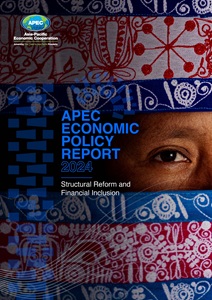
This year’s APEC Economic Policy Report (AEPR) discusses the crucial topic of Structural Reform and Financial Inclusion, addressing both demand-side and supply-side issues through structural reforms to facilitate all people to access and utilise financial services.
The report highlights that financial inclusion should be a deliberate and deliberative process. Inclusion does not spontaneously happen; it needs to be built in from the start and actively implemented. Even as APEC economies have expanded access to financial services—for example, more than 8 in 10 people in the region have a financial or mobile money account—more can be done to ensure that these services are accessible to all people. From incentivising financial sector competition and innovation to promoting financial literacy and reasonable accommodation practices, structural reform can play an important role in expanding equitable access to quality financial services for all people.