Reports
Final Report on A Practical Guide to Safeguard Trade Secrets for MSMEs in APEC Economies
The Asia-Pacific Economic Cooperation (APEC) is a regional economic forum established in 1989 to leverage the growing interdependence of the Asia-Pacific.
The Asia-Pacific Economic Cooperation (APEC) is a regional economic forum established in 1989 to leverage the growing interdependence of the Asia-Pacific.
APEC ensures that goods, services, investment and people move easily across borders. Members facilitate this trade through faster customs procedures at borders; more favorable business climates behind the border; and aligning regulations and standards across the region.
APEC ensures that goods, services, investment and people move easily across borders. Members facilitate this trade through faster customs procedures at borders; more favorable business climates behind the border; and aligning regulations and standards across the region.
APEC has helped drive economic growth and cooperation across the Asia-Pacific by reducing trade barriers, improving the ease of doing business and strengthening connectivity among economies. These efforts have contributed to rising incomes, expanded trade and greater opportunities for businesses and communities across the region.
APEC has helped drive economic growth and cooperation across the Asia-Pacific by reducing trade barriers, improving the ease of doing business and strengthening connectivity among economies. These efforts have contributed to rising incomes, expanded trade and greater opportunities for businesses and communities across the region.
APEC brings together governments, businesses and stakeholders to collaborate on shared priorities. Explore opportunities to participate in events, contribute to initiatives and engage with APEC’s work across the region.
APEC brings together governments, businesses and stakeholders to collaborate on shared priorities. Explore opportunities to participate in events, contribute to initiatives and engage with APEC’s work across the region.
Reports
•June 2026
Download Report
914KB
Published Under
APEC Secretariat, APEC Policy Support Unit
Accessed
1
Pages
16
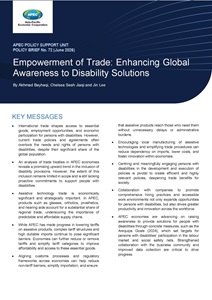
This policy brief examines the relationship between international trade and persons with disabilities by evaluating disability clauses in trade agreements and the trade dynamics of assistive products. The analysis reveals an increase in disability provisions in trade treaties in APEC economies and significant trade volumes in assistive technology.
However, support for persons with disabilities remains limited, with few proactive commitments. While APEC has made progress in lowering applied tariffs on assistive products, complex tariff structures and duties continue to pose barriers. The brief recommends simplifying trade procedures, aligning customs processes, collaborating with the private sector and engaging meaningfully with persons with disabilities in the creation of relevant policies.