Reports
Study on Implementation of the Collaborative Framework and ODR in APEC
The Asia-Pacific Economic Cooperation (APEC) is a regional economic forum established in 1989 to leverage the growing interdependence of the Asia-Pacific.
The Asia-Pacific Economic Cooperation (APEC) is a regional economic forum established in 1989 to leverage the growing interdependence of the Asia-Pacific.
APEC ensures that goods, services, investment and people move easily across borders. Members facilitate this trade through faster customs procedures at borders; more favorable business climates behind the border; and aligning regulations and standards across the region.
APEC ensures that goods, services, investment and people move easily across borders. Members facilitate this trade through faster customs procedures at borders; more favorable business climates behind the border; and aligning regulations and standards across the region.
APEC has helped drive economic growth and cooperation across the Asia-Pacific by reducing trade barriers, improving the ease of doing business and strengthening connectivity among economies. These efforts have contributed to rising incomes, expanded trade and greater opportunities for businesses and communities across the region.
APEC has helped drive economic growth and cooperation across the Asia-Pacific by reducing trade barriers, improving the ease of doing business and strengthening connectivity among economies. These efforts have contributed to rising incomes, expanded trade and greater opportunities for businesses and communities across the region.
APEC brings together governments, businesses and stakeholders to collaborate on shared priorities. Explore opportunities to participate in events, contribute to initiatives and engage with APEC’s work across the region.
APEC brings together governments, businesses and stakeholders to collaborate on shared priorities. Explore opportunities to participate in events, contribute to initiatives and engage with APEC’s work across the region.
Manuals
•July 2026
Download Report
107MB
Published Under
SOM Steering Committee on Economic and Technical Cooperation (SCE), Tourism Working Group (TWG)
Accessed
5
Pages
111
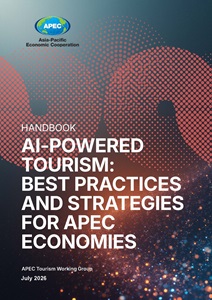
The AI-Powered Tourism: Best Practices and Strategies for APEC Economies was developed under the project Futuristic Frontiers: AI-Led Evolution of Tourism Stakeholders in APEC Economies. The handbook provides an evidence-informed resource to support tourism policymakers, industry stakeholders, associations, and MSMEs in understanding and navigating AI adoption within the tourism sector. Drawing on literature review, hybrid case studies in China; Indonesia; Korea; Malaysia; and Peru; and stakeholder engagement through a capacity-building workshop, the handbook identifies key opportunities, constraints, and enabling conditions for responsible AI adoption. It highlights the importance of policy coherence, digital infrastructure, human capital development, public–private–academic collaboration, ethics, and trust. The project’s key outcome is a strategic approach and phased roadmap to guide APEC economies toward practical, inclusive, and human-centred AI adoption in tourism.