Manuals
APEC Embracing Carers Checklist for Carer-Integrated Health Policy
The Asia-Pacific Economic Cooperation (APEC) is a regional economic forum established in 1989 to leverage the growing interdependence of the Asia-Pacific.
The Asia-Pacific Economic Cooperation (APEC) is a regional economic forum established in 1989 to leverage the growing interdependence of the Asia-Pacific.
APEC ensures that goods, services, investment and people move easily across borders. Members facilitate this trade through faster customs procedures at borders; more favorable business climates behind the border; and aligning regulations and standards across the region.
APEC ensures that goods, services, investment and people move easily across borders. Members facilitate this trade through faster customs procedures at borders; more favorable business climates behind the border; and aligning regulations and standards across the region.
APEC has helped drive economic growth and cooperation across the Asia-Pacific by reducing trade barriers, improving the ease of doing business and strengthening connectivity among economies. These efforts have contributed to rising incomes, expanded trade and greater opportunities for businesses and communities across the region.
APEC has helped drive economic growth and cooperation across the Asia-Pacific by reducing trade barriers, improving the ease of doing business and strengthening connectivity among economies. These efforts have contributed to rising incomes, expanded trade and greater opportunities for businesses and communities across the region.
APEC brings together governments, businesses and stakeholders to collaborate on shared priorities. Explore opportunities to participate in events, contribute to initiatives and engage with APEC’s work across the region.
APEC brings together governments, businesses and stakeholders to collaborate on shared priorities. Explore opportunities to participate in events, contribute to initiatives and engage with APEC’s work across the region.
Proceedings
•July 2026
Download Report
1MB
Published Under
Committee on Trade and Investment (CTI), Sub-Committee on Customs Procedures (SCCP)
Accessed
235
Pages
44
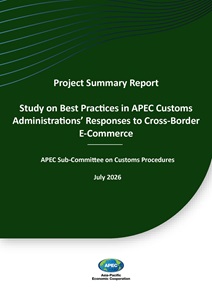
This report presents the outcomes of the APEC project, led by Korea and co-sponsored by Japan; Peru; and the United States, on best practices for applying new technologies and innovative solutions in cross-border e-commerce (CBEC), with a particular focus on customs risk management and customs-business cooperation.
As CBEC rapidly expanded following the COVID-19 pandemic, customs administrations faced increasing challenges in managing growing volumes of low-value consignments while ensuring efficient and secure clearance procedures. To address these challenges, the project conducted a research study and organized an APEC workshop under the Sub-Committee on Customs Procedures (SCCP). The study examined customs procedures, risk management approaches, the use of advance electronic data, technology adoption, and public-private cooperation across APEC member economies. The workshop provided a platform for customs officials, international organizations, and private-sector experts to exchange experiences and best practices, contributing to strengthened customs capacity and enhanced regional cooperation.